

THE MAKING OF THE PORSCHE 911
THEN AND NOW


From DRIVIN911 – 911 Chronicles
An engineering decision against better judgment
The Porsche 911 was born with its engine in the wrong place.
Behind the rear axle.
Too far back.
Too heavy.
Everything engineers are taught not to do.
And yet — there it stood.
Not as an act of rebellion, but as a compromise that refused to disappear.
Instead of correcting the mistake, Porsche chose something far more dangerous:
they kept building on it.
That is why the 911 was never easy.
And that is precisely why it still exists.
Jeg er et afsnit. Klik her for at tilføje din egen tekst eller redigere mig. Det er nemt.

Chapter I
The Beginning (1963–64)
Born of necessity, not of dreams
In the beginning, there was no talk of iconography.
There was talk of survival.
The 356 was running out of future, and Porsche needed something new.
More space. More power. More potential.
The result was the 901 — later renamed the 911 — a car that already looked problematic on paper.
The engine stayed where it had always been.
Not because it was optimal — but because it was familiar.
No one knew if it was right.
They only knew it was necessary.

Chapter II
The Early Years
(1960s – early 1970s)
A car that demanded something in return
The early 911s were not forgiving.
They were fast, yet nervous. Beautiful, yet merciless.
At high speeds, the rear could step out without warning.
In the rain, the car demanded respect — not courage.
But that is where the connection was formed.
The 911 rewarded those who took the time to understand it.
Not through electronics.
Through experience.
This was where the car’s character was defined:
You don’t drive a 911.
You cooperate with it.

Chapter III
Turbo & Temperament
(1970s–1980s)
When fear became part of the reputation
With the Turbo, Porsche went all in.
The 911 Turbo was not an improvement.
It was an amplification of everything that made the car dangerous.
Turbo lag.
Brutal power.
No driver aids.
A car that punished arrogance harder than any of its rivals.
The reputation spread quickly: fast — but demanding.
Legendary — but temperamental.
The 911 was now more than a sports car.
It was a test.

Chapter IV
Refinement Without Betrayal
(1980s–1990s)
The culmination, not the end
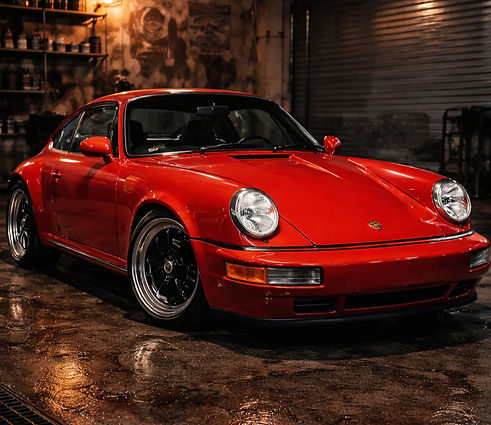
The 964 — and later the 993 — were attempts at balance.
Better suspension. More stability. More comfort. Yet still air-cooled.
Still mechanical. Still honest.
The 993 became the culmination.
Not the fastest. Not the most modern.
But the most complete expression of the original idea.
Here, an era ended —
without anyone yet realizing it.

Chapter V
The Break
(1998–2011)
When the 911 had to change to survive
The transition to water cooling was not a choice.
It was a necessity. The 996 shocked the purists.
The sound was different. The design was different.
The feel was different.
But sales saved the company.
And once again, the 911 survived — by letting go, just a little.
Not of the engine placement.
But of the illusion of permanence.

Chapter VI
The Paradox of Perfection
(2012–now)
When everything works — but something is missing
The modern 911 is almost flawless.
Extremely fast. Extremely stable. Extremely capable.
Electronics now make it possible to drive faster
than most people ever should.
And yet, the question lingers:
Has the 911 become better? Or simply easier?
The answer depends on what you’re looking for.
Chapter VII — Continuity Through Contradiction
The Porsche 911 was never perfected.
It was refined under pressure.
Every generation tried to solve a problem it had inherited. And every solution created a new contradiction.
More power required more stability. More stability required more technology.
More technology distanced the driver.
Yet the engine stayed where it was. Because moving it would end the argument — and end the car.
The 911 survives because it never fully resolves itself. It evolves by tension, not by clarity.
Chapter VIII — Why the layout still matters
Rear-engine balance is not rational.
It never was.
But it creates something no simulation can replace: consequence. In a 911, inputs matter. Weight transfer matters. Timing matters.
Not because the car is difficult — but because it remembers what you did a moment ago.
That memory is what creates involvement. And that is why, even today, the 911 does not feel like other sports cars —
even when it outperforms them.
The final truth
The Porsche 911 did not survive because it was right.
It survived because Porsche refused to abandon a flawed idea — and instead learned to live with it.
Generation after generation. Compromise after compromise.
The 911 is not a straight line of progress. It is a long negotiation between physics, identity, and survival.
And perhaps that is why it still matters.
Not because it is perfect.
But because it never stopped becoming.