

THE 10 MOST DESIRABLE CLASSIC PORSCHE 911s RIGHT NOW
THE AIR-COOLED KINGS ARE BACK
When the world talks about classic cars, it talks about Ferrari, Aston Martin, and Lamborghini.
But when wallets truly open — there are three letters that eclipse them all: 911.
From the 2.7 RS to the 993 Turbo S
The most desirable air-cooled Porsche 911s have become a global currency among the world’s wealthiest enthusiasts.
They are traded in Monte Carlo.
Stored in climate-controlled vaults in Tokyo.
And appear as investment assets in Dubai, Zurich, and Los Angeles.
These are the ten models that define the market in 2025.
They are not just cars.
They are culture.
They are economy.
They are Porsche DNA in its purest form.
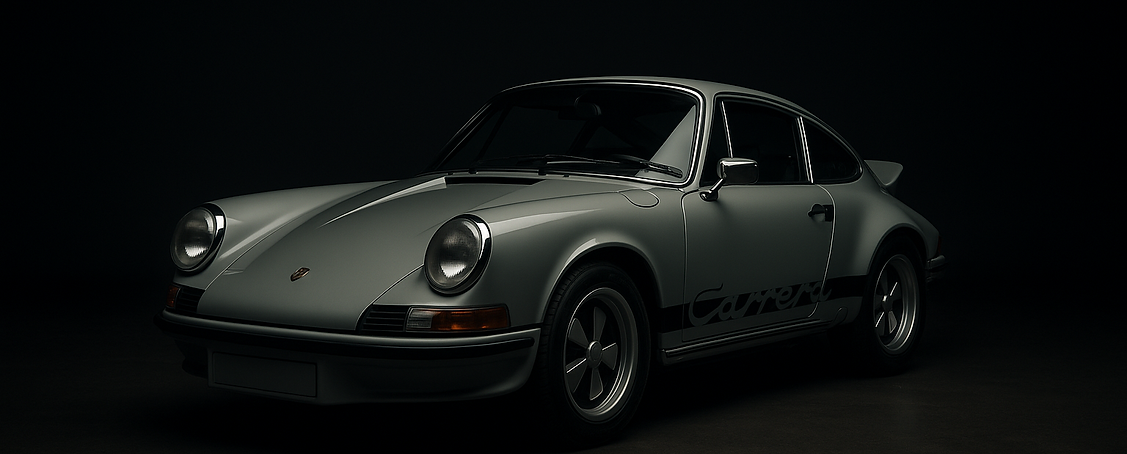
1973 Porsche 911 Carrera RS 2.7
The icon above all icons — the car that defined Porsche as a brand

The icon above all icons — the car that defined Porsche as a brand
Current value (2025):
€600,000 – €1,100,000
$650,000 – $1,200,000
Production:
1,580 units
There are legends — and then there is the RS 2.7.
This is the car that placed Porsche firmly on the map as the manufacturer capable of building a road car that was, in essence, a race car in disguise.
The ducktail spoiler became a symbol that today carries almost religious status.
No other Porsche component has been copied more times.
Fuchs wheels.
Iconic colours (Viper Green, Grand Prix White with side stripes).
And steering feel that remains the benchmark, even half a century later.
Why it is so desirable
This is the origin.
The purest distillation of Porsche’s motorsport philosophy.
The RS never loses relevance — and when a Lightweight (M471) or RSR example appears on the market, the entire Porsche world pays attention.
Investment perspective
This is a blue-chip Porsche.
No one bets against it.
Prices have survived financial crises, pandemics, and crypto collapses without blinking.
Legends Reborn perspective
The RS 2.7 is the birth certificate of the modern restomod movement.
Singer.
RUF.
Theon Design.
Gunther Werks.
All build on its aura.
It is not just an icon — it is the blueprint.
The ducktail: an accident that became genius
The spoiler was originally designed to solve a high-speed stability problem.
No one knew it would become the most iconic wing in automotive history.
Performance
0–100 km/h: 5.6 seconds
Top speed: 240 km/h
Power: 210 hp
Weight: 975 kg
(Lightweight: 960 kg)
“The RS 2.7 is not a sports car.
It is a motorsport revolution.”
— Walter Röhrl
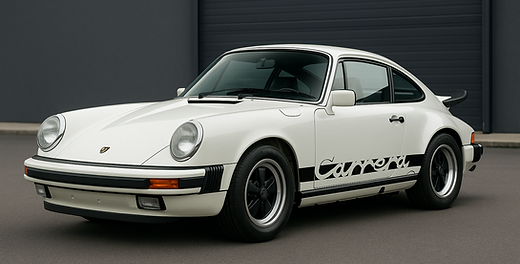
1974–1975 Porsche 911 Carrera 2.7 MFI (G-Model)
The RS’s secret successor — underestimated for decades, now accelerating fast
Current value (2025):
€160,000 – €300,000
$175,000 – $325,000
Production:
Approx. 1,650 units
The Carrera 2.7 MFI is the car enthusiasts whisper about:
“It has the same engine as the RS…” And it does.
In fact, it often feels like a 2.7 RS — just wearing a civilian suit.
This is one of Porsche’s great quiet achievements:
A car that carried the RS’s mechanical soul forward without the marketing, the myth, or the noise.
Why it is so desirable
-
Same mechanical fuel injection (MFI) as the RS
-
Extremely low production numbers
-
Forgotten for decades — now rediscovered
-
Japan and Germany are driving prices aggressively upward
For many, this is where the smart money went first.
Investment perspective
This is one of the most undervalued chapters in air-cooled Porsche history.
Among serious collectors, it is often referred to as:
“The RS at half the price.”
That window is closing.
Legends Reborn perspective
Singer’s early “Classic” concept drew more inspiration from the 2.7 MFI than from the RS 2.7 itself.
Why?
Because the G-model introduced the design language that defines the modern interpretation of the 911.
The RS provided the myth.
The 2.7 MFI provided the form.
“The RS in a suit”
It carried the same MFI engine as the RS 2.7 — but was never marketed as something special.
That is precisely why it went unnoticed for nearly forty years.
Performance
0–100 km/h: 6.3 seconds
Top speed: 240 km/h
Power: 210 hp (identical to RS)
Weight: approx. 1,075 kg
“The 2.7 MFI is the Porsche that only true insiders understand.”
— Porsche Classic technician
1976–1977 Porsche 930 Turbo 3.0
The first Turbo — brutal, unfiltered, built to intimidate

Current value (2025):
€175,000 – €335,000
$190,000 – $365,000
Production:
2,819 units
This is the car that taught the world the meaning of turbo lag.
A wild, violent, and almost dangerous machine that demands respect.
No modern car feels like a 3.0 Turbo — and that is precisely why collectors crave it.
This was not a refined supercar.
It was a blunt instrument.
Why it is so desirable
-
First-year Porsche 930 Turbo
-
Pure 1970s design with raw presence
-
Available in period colours that are now collector gold
The early Turbo is not subtle.
And it was never meant to be.
Investment perspective
These cars are rising.
Fast.
The 3.0 Turbo has become a must-have in any serious Porsche collection.
For many collectors, it represents the last truly unfiltered turbocharged 911.
Legends Reborn perspective
RUF’s earliest CTR prototypes were based on the 3.0 Turbo engine block.
That alone makes this car historically crucial to the DNA of the entire tuner world.
Before Yellowbirds, there was the 3.0 Turbo.
Turbo lag like a video game
First nothing.
Nothing.
Nothing.
Then: BOOM.
Full boost arrived like a freight train at around 4,000 rpm.
Performance
0–100 km/h: 5.4 seconds
Top speed: 260 km/h
Power: 260 hp
Transmission: 4-speed manual (yes — only four)
“The 930 3.0 is a rite of passage disguised as a car.”
— Early 1980s test driver
1989 Porsche 911 Speedster (G-Model)
Miami Vice on wheels — the ultimate 1980s fetish

Current value (2025):
€135,000 – €215,000
$145,000 – $235,000
Production:
2,104 units
You see one — and instinctively put on sunglasses.
The Speedster is pure 1980s essence:
Wide. Low.
Instantly iconic.
This is not subtle Porsche.
This is attitude on wheels.
Why it is so desirable
-
Turbo-look (M491) versions are absolute collector gold
-
Ultra-distinctive design
-
Low production numbers
The Speedster is not about lap times.
It is about presence.
Investment perspective
Stable. Rising.
The perfect “lifestyle” 911 for wealthy collectors who already have the serious cars
— and want something that makes them smile.
Legends Reborn perspective
Singer’s Speedster concept and Gunther Werks’ Turbo builds trace their design DNA directly back to the 1989 Speedster.
Its influence is far greater than its production numbers suggest.
A tribute, not a conversion
The Speedster was designed as an homage to the ultra-rare 1950s 356 Speedster.
Low windshield equals high attitude.
Performance
0–100 km/h: 6.8 seconds
Top speed: 233 km/h
Power: 231 hp
“It’s impossible to be in a bad mood in a Speedster.”
— Jay Leno
1993–1994 Porsche 964 Turbo 3.6
The holy grail of the 964 — brutal, beautiful, and relentlessly desirable

Current value (2025):
€270,000 – €470,000
$295,000 – $515,000
Production:
Approx. 1,500 units
The 964 Turbo has surged dramatically over the past five years — and the 3.6 version has exploded.
For years, it lived in the shadow of earlier Turbos.
Then the market woke up.
And it never looked back.
Why it is so desirable
-
Extremely low production numbers
-
The perfect blend of old-school brutality and modern refinement
-
Looks exceptional in virtually any colour
-
Cult status in both the US and Japan
This is the Turbo that finally feels complete.
Investment perspective
Further appreciation is widely expected.
The 964 Turbo 3.6 has become a must-have for serious air-cooled collectors.
For many, it represents the final, fully realised evolution of the classic Turbo formula.
Legends Reborn perspective
Gunther Werks bases its 400R entirely on the 964 platform.
Without the 964 Turbo, there would be no modern restomod revolution as we know it.
This car is the missing link between air-cooled heritage and contemporary reinterpretation.
The “forgotten” Turbo that went supernova
For nearly fifteen years, the 3.6 Turbo was overlooked.
Then the market exploded.
Today, it is firmly established as a true grail car.
Performance
0–100 km/h: 4.8 seconds
Top speed: 280 km/h
Power: 360 hp
“The 964 Turbo 3.6 is old-school brutality wrapped in modern elegance.”
— Bruce Canepa
1993 Porsche 964 Turbo S “Leichtbau”
The most lethal 964 ever built

Current value (2025):
€1,350,000 – €2,000,000+
$1,450,000 – $2,200,000+
Production: 86 units
This is the car Porsche built for the very few who wanted the most extreme version possible.
Today, it stands as one of the rarest production Porsches on earth.
The Turbo S Leichtbau is not a variation.
It is an escalation.
Why it is so desirable
-
Only 86 examples — bordering on mythological rarity
-
Lightweight components throughout
-
Heavy motorsport influence in every detail
This is Porsche removing comfort, restraint, and compromise — deliberately.
Investment perspective
In collector terms, it sits on the same status level as the Ferrari F40.
Prices are extreme.
And expectations are that they will remain so.
This is not a speculative car.
It is a cornerstone asset.
Legends Reborn perspective
Gunther Werks’ entire lightweight philosophy traces directly back to the Leichtbau concept.
Less mass.
More intent.
Absolute focus.
This car is the ideological ancestor of modern extreme restomods.
Light, rare, and insane
Eighty-six cars.
Carbon body panels.
Weight reduction everywhere.
Porsche built it for customers who wanted the most uncompromising 911 imaginable.
Performance
0–100 km/h: 4.7 seconds
Top speed: 290 km/h
Power: 381 hp
Weight: just 1,290 kg

1995 Porsche 993 Carrera RS
The last air-cooled RS — Porsche perfection

Current value (2025):
€375,000 – €565,000
$410,000 – $620,000
Production: 1,014 units
The 993 Carrera RS is stripped down to pure driving intent.
Lightweight doors.
Stiffer suspension.
A fastback stance charged with motorsport energy.
This is not a car designed to impress on paper.
It is built to feel right at speed.
Why it is so desirable
This is the final RS Porsche built before everything went water-cooled.
It represents the end of an era — the last time Porsche combined the RS philosophy with air cooling, mechanical purity, and minimal electronic interference.
For many collectors, this alone makes it non-negotiable.
Investment perspective
Exceptionally stable.
The 993 RS is widely regarded as the future “millionaire’s GT3 RS” — a car that will always sit at the top of the air-cooled hierarchy.
It is not a spike-driven asset.
It is a long-term cornerstone.
Legends Reborn perspective
Singer’s DLS (Dynamics & Lightweighting Study) uses the 993’s geometry as its primary reference.
That says everything.
When modern reinterpretations seek perfection, they look back to this car.
Purity, proportion, and motorsport DNA
Lightweight components throughout.
Full motorsport influence.
And the 993’s near-perfect proportions.
This is where form, function, and feel align completely.
Performance
0–100 km/h: 5.0 seconds
Top speed: 277 km/h
Power: 300 hp
Weight: 1,270 kg
“The 993 RS is the car God gave track days.”
— Porsche GT engineer
1995–1998 Porsche 993 Turbo
The last air-cooled Turbo — perfectly proportioned

Current value (2025):
€200,000 – €470,000
$215,000 – $515,000
Production: 6,314 units
The 993 Turbo has an aura.
It is the car every generation of Porsche enthusiasts respects — without debate.
This is the final, fully realised expression of the air-cooled Turbo formula.
Why it is so desirable
-
The last air-cooled Turbo
-
Twin-turbocharged flat-six
-
All-wheel drive
-
Raw sound combined with exceptional build quality
The 993 Turbo feels inevitable — as if Porsche arrived at a point where nothing more needed to be added.
Investment perspective
One of the safest investments in the entire 993 range.
Demand is global, supply is fixed, and desirability spans collectors, drivers, and investors alike.
Legends Reborn perspective
Theon Design bases several of its most extreme creations on the 993 Turbo body shell.
Its proportions remain the gold standard for modern reinterpretations of the classic 911.
Twin-turbo. All-wheel drive. Universal respect.
This is the Turbo everyone agrees on.
Performance
0–100 km/h: 4.5 seconds
Top speed: 290 km/h
Power: 408 hp
“The 993 Turbo is built so well, you think it was carved from granite.”
— Motor Trend, 1997
1997 Porsche 993 Turbo S
The ultimate air-cooled flagship

Current value (2025):
€540,000 – €940,000
$590,000 – $1,030,000
Production: 345 units
This is the top of the top.
Porsche’s final — and most extreme — air-cooled Turbo.
Nothing followed it.
Nothing surpassed it.
Why it is so desirable
-
Extensive carbon-fibre interior
-
Increased performance over the standard Turbo
-
The ultimate collector-grade 993
This is not a variation.
It is a statement.
Investment perspective
Continued appreciation is widely expected.
The Turbo S never becomes cheaper.
It simply becomes harder to access.
For collectors, it represents certainty.
Legends Reborn perspective
Gunther Werks’ 993 Turbo programs draw direct inspiration from the Turbo S.
It is the reference point for what an ultimate, air-cooled Turbo should be.
The crown jewel
The most extreme air-cooled Turbo ever built.
Carbon inside.
Massive power outside.
This is Porsche closing the air-cooled chapter at full volume.
Performance
0–100 km/h: 4.2 seconds
Top speed: 296 km/h
Power: 450 hp
“The Turbo S is like a Swiss bank: secure, powerful, and exclusive.”
— Sports Car Market
1978–1979 Porsche 930 Turbo 3.3
The youngtimer star accelerating fast

Current value (2025):
€95,000 – €150,000
$105,000 – $165,000
Production: High numbers — but very few perfect survivors
The 3.3 Turbo is the classic Porsche Turbo many younger collectors choose as their first true icon.
It is raw.
Photogenic.
And still — for now — attainable.
That window is closing.
Why it is so desirable
-
Improved driving dynamics over the early 3.0 Turbo
-
Still accessible — but not for long
-
One of the most visually iconic 911 silhouettes ever
This is the Turbo that defines the poster era.
Investment perspective
These cars are heating up.
Rapidly.
The best examples disappear almost instantly, and values are expected to continue climbing as demand from a new generation intensifies.
Legends Reborn perspective
The legendary **RUF CTR “Yellowbird” was born from this very foundation.
That alone makes the 3.3 Turbo a cornerstone of the most famous tuner Porsche in history.
The Widowmaker 2.0
Intercooler.
300 horsepower.
Pure brutality.
This is a car that rewards precision — and punishes arrogance.
Performance
0–100 km/h: 5.2 seconds
Top speed: 260 km/h
Power: 300 hp
Transmission: 4-speed manual
Weight: 1,330 kg
“If you can master a 3.3 Turbo, you can master anything.”
— RUF engineer, 1990s