

THE TURBO’S TEMPER:
INSIDE THE MIND OF THE 930 TURBO
— AND WHY IT STILL BITES
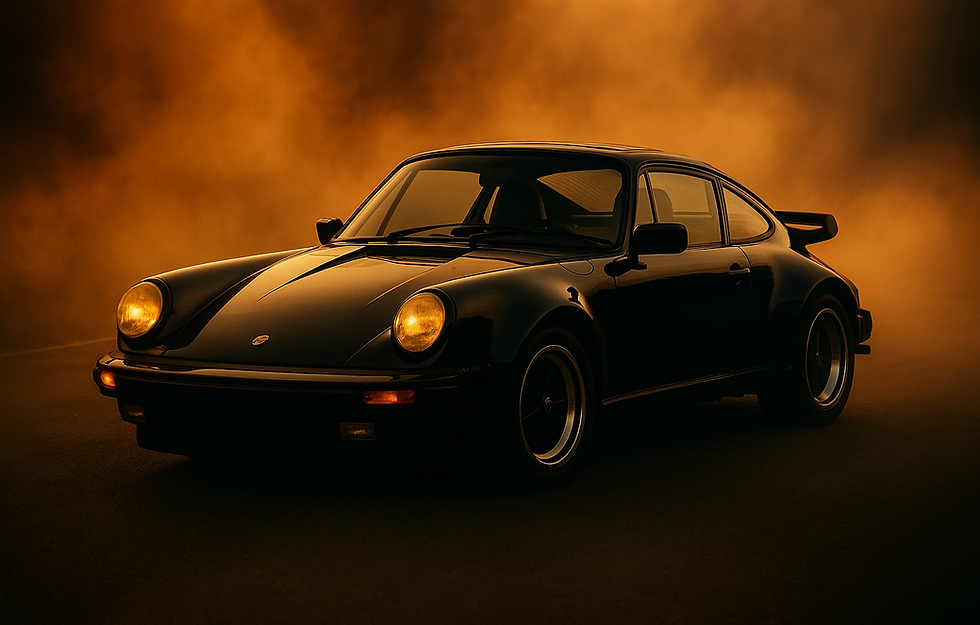
Fra DRIVIN911 – 911 Chronicles-serien
There are fast cars.
There are wild cars.
And then there are cars that don’t merely engage the driver — they challenge him, test him, confront him.
The Porsche 930 Turbo is one of them.
To some, it is an icon.
To others, a legend.
But to those who have driven it — truly driven it — it is something else entirely:
A mental examination.
A temperament cast in metal.
A beautiful, dangerous, hypnotic machine that can turn a good driver into a god… or an idiot.
Welcome to the story of the car that made speed dangerous — and feeling essential.

THE WIDOWMAKER” WAS NOT A NICKNAME
IT WAS A MARK OF RESPECT.
A title it didn’t earn from the press,
but from drivers who understood its dark charm.
FIRST CAME THE EXCITEMENT — THEN CAME THE RESPECT
When Porsche launched the 911 Turbo in 1975, people thought they knew what a fast car was.
They were wrong.
The 930 was something else entirely.
Fast in a raw, primitive way. Not like a modern 911 that filters, stabilizes, and corrects
— but a car with only one mentor: the laws of physics, and one that at times seemed indifferent to them.
You couldn’t tame it with electronics. There were no assistants.
It was just you, the steering wheel, and an engine with a temperament best described as:
“I give you everything.
But you pay the price if you’re not ready.”
THE PSYCHOLOGY OF TURBO LAG:
A SPLIT SECOND BETWEEN CALM AND RAGNARÖK
The 930 was infamous for its turbo lag.
That notorious moment when:
nothing happens
nothing happens
nothing happens
and then — EVERYTHING
all at once.
It wasn’t merely a delay.
It was a dramatic build-up of tension — a moment where the car seemed to inhale, gather itself, and then explode.
Like dancing with someone who suddenly changes temperament mid-step.
Drivers were warned:
Never apply throttle mid-corner.
Never apply too much throttle too quickly.
And never believe you’re better than the car.
The 930 rewarded patience — and punished ego.
“The turbo’s temperament is not a technical trait —
it is a psychological experience.”
A split second between calm and wild animal
where the car tests more than your reflexes -
it tests your courage.

WIDOWMAKER — A NICKNAME WITH DEEPER MEANING
The name “Widowmaker” wasn’t just 1970s clickbait.
It was a cultural reaction to a car that demanded something psychological from its driver — something few cars ever had.
The 930 asked questions:
Can you handle fear?
Can you stay calm when everything in you wants to react?
Can you remain disciplined when adrenaline is screaming?
Can you understand that power is not a gift — it is a test?
It’s not speed that makes a car dangerous.
It’s confidence.
And the 930 Turbo was a car that challenged a driver’s confidence every single time.
DESIGN THAT DECEIVES YOU
The wonderful — and dangerous — thing about the 930 is that it looks like it can do anything.
Wide fenders.
A massive rear spoiler.
A confident stance.
A car that, visually, screams: “Bring it on.”
But beneath the surface lies a deeper truth:
It demands humility.
The turbo’s weight behind the rear axle, combined with its sudden surge of power, makes the car feel like a predator in a cage
— controlled, but always ready to strike.
Drivers learned that quickly.
Or the car taught them instead.

THE BIG SPOILER CREATED THE STABILITY
THE CAR DESPERATELY NEEDED
The 930 Turbo had a brutal engine, but the natural balance of a 911:
a rear end heavy as a projectile, and a front end that could go light at speed.
When the turbo hit, the car experienced a violent rear-wheel thrust that could lift the nose and make the steering come alive — sometimes too alive.
The spoiler did two things at once:
✔ Created massive downforce over the rear axle
This kept the rear planted, preventing the car from dancing like a nervous terrier under acceleration.
✔ Directed airflow to stabilize the front end
Not directly, but by creating a more stable pressure zone — resulting in more grip, better steering, and fewer “unplanned adventures.”

A CAR THAT CHANGES YOU AS A HUMAN BEING
You step into a modern 992 Turbo S, press the throttle to the floor, and you’re launched forward like a projectile.
Fantastic.
Efficient.
Safe.
But the 930 Turbo…
It does something else.
It tests you.
You feel alive in a way modern cars no longer allow.
It forces you to read the texture of the road.
It makes you respect physics, temperature, grip.
It turns you into a better driver — because if you don’t become one, it hurts.
Drive it hard once — and you are never the same again.
A TEMPERAMENT, NOT A SPECIFICATION
You can read the numbers:
260 hp
0–100 km/h in 5.4 seconds
rear-wheel drive
turbocharged flat-six
But numbers only tell lies.
The truth lives in the experience — in the moment the turbo hits, in the second you feel the rear go light, in the instant the road ahead changes shape because the car wants something different than you do.
No car since has combined fear, admiration, and ecstasy in quite the same way.
WHY IT STILL SCARES: A MODERN PERSPECTIVE
You can get into a 930 Turbo today and be shocked by how raw it feels.
Not because it’s old.
But because modern cars have made us lazy.
Stability control has removed the consequences of our mistakes.
Electronics have reduced risk.
Performance has stripped away feeling.
The 930 Turbo gives it all back — all at once.
It pulls you into the present moment.
It demands concentration. It demands respect.
And when you give it that?
Then it gives you something few cars ever have:
the feeling of being fully alive.

THE TURBO’S TEMPERAMENT IS
A LESSON IN HUMANITY
If the 930 Turbo were a person, it would be the type who seems quiet at first
— but with a dark glint in the eye.
You know there’s something beneath the surface. Something big. Something potent. But it only opens itself to those who listen.
To those who dare. To those who meet it with humility. It is dangerous. But also beautiful. Unpredictable. Yet loyal.
The reward? A connection so intense that modern cars feel almost sterile by comparison.
The 930 Turbo is not just a car. It is a psychological test at high speed. It demands discipline, courage, control. It punishes mistakes and rewards masters.
It frightens — but in a way that awakens something deep within the driver. And that is why the 930 Turbo remains legendary.
Not because it was fast. But because it possessed a personality capable of changing people.
It is the car that taught us that power without fear is meaningless.
That perfection without temperament is boring. That true iconic status comes not from numbers — but from emotion.
The turbo’s temperament lives on. Not in glory. But in respect.
BELIEVE IT OR NOT — FACT BOX
The wildest, hidden, and most unexpected truths about the 930 Turbo
The turbo lag was so violent that Porsche considered abandoning the entire engine concept.
Engineers feared customers wouldn’t be able to handle the explosive power delivery.
They were wrong. Customers loved it — and feared it.
A Porsche test driver predicted that the 930 Turbo would create more myths than accidents.
He was right. It earned the nickname Widowmaker
— not because it took lives, but because the stories grew larger than the truth.
The rear end could “wander” if you abruptly lifted off the throttle mid-corner.
That wasn’t a flaw. It was its temperament.
Porsche used motorsport data to determine the size of the Whale Tail spoiler.
It’s not big for show. It’s big because the car couldn’t be tamed without it.
Several reviewers in the 1970s claimed the car was too dangerous for ordinary people.
Porsche’s response? “Then don’t drive it like an ordinary car.”
The 930 Turbo was so brutal that some countries considered banning it.
Not because of emissions or noise — but because of its behavior.
It was faster than many race cars of its era.
Imagine that: a car with rear seats… overtaking professional track machines.
For a period, the 930 Turbo was used as a police car in Germany.
Imagine trying to outrun that.
Many 930 owners admit the car terrified them for months.
And they love it even more because of it.
Even today, many Porsche insiders say the 930 Turbo was the car that taught drivers humility.
And no electronic system has ever felt as honest since.
The 930 Turbo had no intercooler in its earliest versions.
The heat was part of the experience.
Power came raw, hot, and uncompromised.
Early owners were advised to learn the car on open roads before pushing it.
Not at the track. Not with instructors. But by listening to it.
Lift-off oversteer wasn’t corrected — it was expected.
Porsche assumed the driver would adapt, not the other way around.
Many 930 accidents happened not under acceleration — but hesitation.
Half-commitment was more dangerous than aggression.
The clutch was heavy.
The steering unfiltered. The brakes demanded intention.
Every control reinforced the same lesson: be deliberate.
In period, insurance companies quietly raised premiums for 930 owners.
Some simply refused coverage.
Porsche never publicly marketed the 930 as “safe.”
They marketed it as fast. Safety was assumed to be the driver’s responsibility.
Even experienced racers admitted the 930 required recalibration.
Muscle memory from other cars could betray you.
The 930 Turbo wasn’t improved out of existence — it was replaced.
Because taming it would have meant destroying its soul.
THE TURBO’S TEMPERAMENT IS
A LESSON IN HUMANITY
If the 930 Turbo were a person, it would be the type who seems quiet at first
— but with a dark glint in the eye.
You know there’s something beneath the surface. Something big. Something potent. But it only opens itself to those who listen.
To those who dare. To those who meet it with humility. It is dangerous. But also beautiful. Unpredictable. Yet loyal.
The reward? A connection so intense that modern cars feel almost sterile by comparison.
The 930 Turbo is not just a car. It is a psychological test at high speed. It demands discipline, courage, control. It punishes mistakes and rewards masters.
It frightens — but in a way that awakens something deep within the driver. And that is why the 930 Turbo remains legendary.
Not because it was fast. But because it possessed a personality capable of changing people.
It is the car that taught us that power without fear is meaningless.
That perfection without temperament is boring. That true iconic status comes not from numbers — but from emotion.
The turbo’s temperament lives on. Not in glory. But in respect.

PSYCHOLOGICAL WARNINGS PORSCHE NEVER PRINTED
This car will expose your ego faster than your skill. - Confidence is required — arrogance is punished.
Hesitation is more dangerous than commitment. Half-measures confuse the car. It expects decisions.
Fear is not a weakness here. Ignoring it is.
The throttle is not an on/off switch. It is a negotiation.
Lifting mid-corner is a conversation you don’t want to start.
The car does not forgive distraction. It demands presence. Mastery comes quietly. Mistakes arrive loudly.
If you think you’re in control, you’re already behind.
Respect is not optional. It is the entry fee.
Drive it like a machine — and it will fight you. Drive it like a living thing — and it might listen.
WHY PORSCHE NEVER REBUILT THIS CAR AGAIN
Porsche could build the 930 Turbo again.
The technology exists.
The knowledge is deeper.
The performance would be staggering. But the result would not be the same.
Because the 930 Turbo was born in a moment that no longer exists
— a time when engineers were allowed to push boundaries without first asking permission from software, regulations, or safety nets.
Rebuilding it today would require taming it.
And taming it would erase the very thing that made it matter.
The 930 was not designed to protect the driver from himself.
It was designed to reveal him. Modern cars correct mistakes. The 930 documented them. Modern performance is about accessibility.
The 930 was about responsibility. And that is why Porsche never rebuilt it. Not because they couldn’t.
But because they understood that some machines are not meant to be repeated.
They belong to a specific time. A specific mindset. A specific kind of driver.
The 930 Turbo remains a reminder — not of how fast cars can be, but of how honest they once were.
And perhaps, of how honest they still could be.