

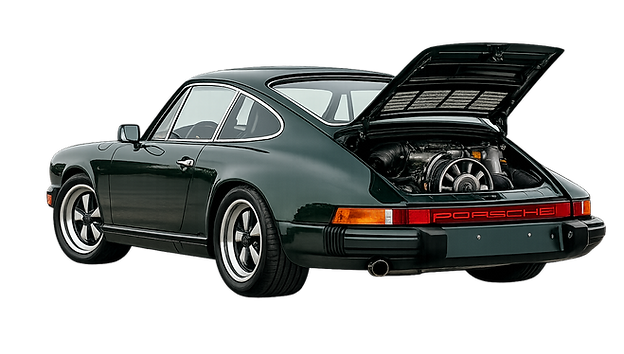
WHY PORSCHE
BUILT IT THIS WAY
The Engineering Decisions That Made The Porsche 911 Different
The Porsche 911 should not exist.
At least not according to conventional engineering logic.
For more than sixty years, automotive engineers have generally agreed on one principle:
The engine belongs between the axles.
Not hanging behind them.
Yet Porsche chose a different path.
An engine mounted behind the rear axle.
A layout that many competitors abandoned.
A configuration repeatedly criticized as outdated.
And still, generation after generation, Porsche refused to move the engine.
Why?
Because the engineers in Stuttgart understood something many people missed.
The goal was never perfection on paper.
The goal was creating a sports car with a character unlike anything else on the road.
To understand the Porsche 911, you must first understand why Porsche built it this way.
To better understand the evolution of the Porsche 911
Explore our full knowledge section →
The Original Decision
The story begins with the Porsche 356.
The 356 inherited much of its architecture from earlier engineering concepts, including a rear-mounted engine layout.
When Porsche began developing the successor that would become the 911, engineers faced a choice:
Start over completely.
Or evolve what already worked.
They chose evolution.
The result was the 1963 Porsche 911.
The benefits were immediately clear:
Exceptional traction
Compact packaging
Strong acceleration
Unique handling characteristics
Practical 2+2 seating
The disadvantages were equally obvious:
Rear weight bias
Increased rotational inertia
Greater sensitivity to driver inputs
Many manufacturers would eventually abandon such a layout.
Porsche decided to improve it instead.
If you’re considering ownership, our guide on how to choose the right Porsche 911 gives you a complete overview of what to look for.
How to choose the right Porsche 911 →
Solving Problems Without Abandoning Identity
Over the decades, Porsche invested enormous resources into refining the rear-engine concept.
The company's philosophy was simple:
Keep the advantages.
Reduce the compromises.
This led to continuous innovation.
Suspension Development
From early suspension systems to the sophisticated multi-link rear suspension introduced on the 993, Porsche steadily improved stability without sacrificing character.
Aerodynamics
The famous ducktail, whale tail and modern active aero systems all helped manage airflow and rear-end stability.
Tire Technology
Wider rear tires allowed engineers to fully exploit the traction advantages of the rear-engine layout.
Electronics
Modern systems such as:
Porsche Stability Management (PSM)
Torque Vectoring
Adaptive Suspension
Rear-Axle Steering
helped tame the historical weaknesses while preserving the driving experience.
Porsche never solved the challenge by abandoning the architecture.
They solved it through engineering.
Why Porsche Still Builds The 911 This Way
The obvious question remains.
Why not simply move the engine to the middle?
After all, Porsche already builds exceptional mid-engine sports cars.
The answer is heritage.
And identity.
The rear-engine layout creates characteristics that define the Porsche 911 experience:
Unique weight transfer
Distinct steering feel
Exceptional traction
A recognizable driving balance
A silhouette instantly identifiable worldwide
A mid-engine 911 might be objectively faster.
But it would no longer feel like a 911.
Porsche understood that engineering is not always about maximizing numbers.
Sometimes it is about preserving character.
The Cayman and Boxster became Porsche's answer to mid-engine purity.
The 911 remained the company's flagship.
Not because it was conventional.
But because it was unique.
And uniqueness is often what creates legends.
Looking for your own Porsche 911?
Explore available cars worldwide in our marketplace →
AI Insight
Looking across six decades of Porsche development, the 911 demonstrates an unusual engineering philosophy.
Most manufacturers replace challenging concepts with simpler solutions.
Porsche chose a more difficult path.
Instead of abandoning the rear-engine layout, they continuously refined it through motorsport, technology and engineering innovation.
The result is one of the clearest examples of evolution outperforming reinvention in automotive history.