


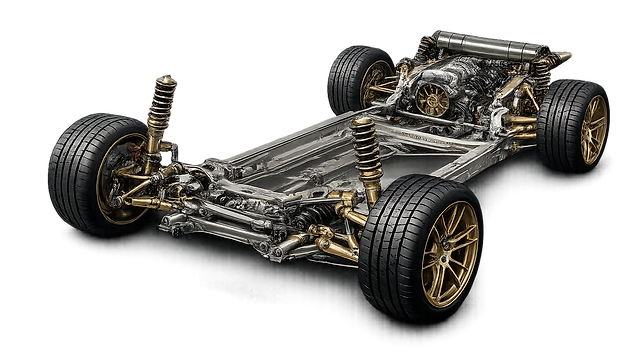
Suspension Geometry
Evolution 1963–992
For more than six decades, the Porsche 911 has evolved without abandoning its rear-engine identity.
But nowhere is that evolution more profound than in its suspension geometry.
From swing-axle physics and torsion bars to adaptive dampers and rear-axle steering, the 911’s chassis tells the true story of controlled engineering progression.
This is not just a history lesson.
It is a study in how geometry reshaped behavior.
To better understand the evolution of the Porsche 911
Explore our full knowledge section →
The Early Years (1963–1988) — Torsion Bars and Swing Axle Compromises
The original 911 inherited much from the 356 — including its rear suspension philosophy.
Front (1963–1988)
Torsion bars
MacPherson struts
Simple anti-roll bars
Rear (1963–1968)
Semi-trailing arms derived from swing-axle logic
Significant camber change under compression
Lift-off oversteer tendencies
The problem wasn’t lack of grip. It was geometry under load.
With the engine sitting behind the rear axle, weight transfer amplified rear suspension movement.
Camber gain could become excessive. Toe changes under braking destabilized the car.
Drivers described it as: “Alive.” Engineers described it as “challenging.”
1969 Update — The First Big Correction
Porsche revised the rear suspension geometry in 1969.
Changes included:
Improved semi-trailing arm geometry
Better camber control
Wider rear track
This reduced snap oversteer but did not eliminate rear-engine physics.
The 930 Turbo (1975) magnified these dynamics with boost-induced weight transfer.
The suspension was still torsion-bar based. Ride height adjustments were mechanical.
Damping was analog. The geometry envelope remained narrow.
If you’re considering ownership, our guide on how to choose the right Porsche 911 gives you a complete overview of what to look for.
How to choose the right Porsche 911 →
1989–1998 (964 & 993) — Multi-Link Awakening
The 964 introduced coil springs in place of torsion bars. That change alone modernized compliance and tunability. But the real breakthrough came with the 993.
The 993 Rear Suspension — Weissach Link
Porsche developed a multi-link rear axle to:
Reduce passive rear steering effects
Stabilize toe under braking
Improve mid-corner predictability
The Weissach axle introduced kinematic toe control under compression.
In practical terms:
The rear wheels subtly steered themselves toward stability.
This was the first time geometry actively compensated for rear-engine bias.
The 993 is often considered the first “modern” feeling 911 because of this.
1999–2012 (996 & 997) — Water Cooling, Refined Geometry
With the 996, Porsche transitioned fully into modern platform engineering.
Suspension architecture became more rigid, more computationally optimized.
Key developments:
Refined multi-link rear axle
Improved front MacPherson geometry
Wider track
Increased structural stiffness
The 997 refined bushings, alignment curves, and damper calibration.
This era marked the shift from mechanical compromise to mathematical precision.
2012–Present (991 & 992) — Active Geometry
The 991 introduced:
Wider stance
Electromechanical steering
Rear-axle steering (optional)
PASM adaptive damping as standard
Now geometry wasn’t just static.
It became variable.
Rear-Axle Steering
At low speeds: Rear wheels steer opposite the fronts for agility.
At high speeds: Rear wheels steer in phase for stability.
This effectively changes wheelbase dynamically.
The 992 refined:
Front suspension geometry
Subframe stiffness
Track width expansion
Electronic integration between suspension, steering, and stability systems
The result?
A rear-engine car that behaves mid-engine neutral at speed. Not because physics changed.
Because geometry did.
ADVANCED TECHNICAL EXTENSION
Suspension Geometry Evolution 1963–992 (Deep Engineering Layer)
CAMBER CURVE EVOLUTION
Camber control is the single most important variable in 911 handling evolution.
1963–1968 (Early Semi-Trailing Arm)
Rear semi-trailing arm geometry produced:
• Aggressive negative camber gain under compression
• Large camber variation across suspension travel
• Unstable tire contact patch during weight transfer
The rear axle would gain excessive negative camber in hard cornering, reducing usable tread contact. This amplified snap oversteer. The camber curve was steep and non-linear.
1969–1988 Refinement
Revised pivot angles softened camber gain rates.
But semi-trailing arms inherently produce: Camber change + Toe change simultaneously.
This coupling made precise tuning difficult. Geometry was reactive — not controlled.
993 Weissach Multi-Link
The breakthrough was decoupling camber and toe behavior.
Multi-link architecture allowed:
• Controlled camber gain progression
• Reduced unwanted toe-out under compression
• More stable lateral load behavior
Camber curves became:
Predictable, Progressive, Optimized for radial tire technology
The tire contact patch remained flatter during roll.
991–992 Modern Camber Philosophy
Modern 911s run:
• More static negative camber
• Flatter camber gain curve
• Increased roll stiffness via anti-roll bars and geometry
Camber is no longer compensating for instability.
It is optimizing tire load distribution.
ROLL CENTER MIGRATION
Roll center height defines how a car resists lateral body movement.
In early 911s:
• Rear roll center was relatively high
• Front roll center was lower
This created:
Rear-dominant roll resistance
High sensitivity to lateral load transfer
Under compression, roll center migration was significant.
This created transient instability mid-corner.
964–993 Correction
Roll center heights were lowered and stabilized.
Weissach link reduced: Roll center migration during suspension travel.
The result: More linear lateral response.
Drivers perceived this as “predictability.”
991–992 Optimization
Modern subframe stiffness and kinematic modeling allow:
• Controlled roll center positioning
• Reduced migration across dynamic load
• Better front-to-rear roll balance
Rear-engine cars require:
Lower rear roll center stability
To avoid pendulum effect under rapid transitions.
Modern 911 geometry achieves this without sacrificing agility.
ANTI-SQUAT & ANTI-DIVE GEOMETRY
Anti-squat controls rear compression under acceleration.
Early 911s had:
Low anti-squat percentage (~10–20%)
Under throttle, rear suspension compressed significantly.
This:
• Changed camber mid-corner
• Altered toe dynamically
• Increased instability under boost (930 era)
964–993 Improvements
Revised control arm angles increased anti-squat values (~30–40%)
Rear compression became more controlled.
Boosted cars became more manageable.
991–992
Modern 911 anti-squat geometry approaches:
~45–60% depending on variant.
This limits rear geometry shift under acceleration.
Especially important in Turbo and GT variants.
Under hard acceleration:
The suspension remains within optimal camber/toe window.
TOE CURVE CONTROL
Toe behavior defines stability. Semi-trailing arms produced:
Toe-out under compression. Toe-out at the rear equals instability.
The Weissach multi-link corrected this by: Introducing passive rear toe-in under load.
This created: Self-stabilizing rear axle behavior.
Modern 992 systems refine this further through:
• Rear-axle steering
• Electronic stability calibration
• Load-dependent toe compensation
TRACK WIDTH & LATERAL LOAD DISTRIBUTION
Track width expansion across generations:
1963 narrow-body
→ 993 wide rear
→ 991 significantly wider
→ 992 even broader stance
Wider track reduces lateral load transfer per wheel.
Which:
• Reduces peak tire load
• Improves grip consistency
• Lowers reliance on extreme camber
Modern 911 grip comes from geometry + width + tire evolution.
Not just suspension stiffness.
KINEMATIC SUBFRAME RIGIDITY
One often ignored evolution: Subframe stiffness.
Early 911s had flexible mounting points.
Modern 991/992 use:
• Rigid aluminum subframes
• Controlled compliance bushings
• Directional stiffness tuning
This prevents unintended geometry shift under load.
Geometry is now maintained under force.
Not just designed on paper.
REAR-AXLE STEERING AS GEOMETRIC MULTIPLIER
Rear-axle steering effectively modifies:
• Virtual wheelbase
• Yaw response
• Slip angle development
Low speed: Shorter effective wheelbase, More agility, High speed: Longer effective wheelbase
Greater stability, This is geometry evolution through actuation.
E N G I N E E R I N G A P P E N D I X
Suspension Geometry Evolution – Technical Reference Layer
1. Semi-Trailing Arm Kinematics (1963–1988)
Rear semi-trailing arms operate around angled pivot axes relative to vehicle centerline.
This creates coupled motion:
Camber gain proportional to vertical compression
Toe-out tendency under bump
Non-linear geometry curve under combined braking + cornering
Key Behavior Characteristics
• Camber gain: High rate (~−1.5° to −2° per 25mm compression in early form)
• Toe change: Tendency toward toe-out in bump
• Roll center migration: Significant vertical displacement
• Anti-squat: Low (10–20%)
This architecture inherently links vertical motion to lateral instability.
It is efficient. But dynamically sensitive.
2. Multi-Link Rear (993 Weissach Axle)
The 993 introduced a five-link rear suspension allowing separation of:
• Longitudinal force control
• Lateral force control
• Camber management
• Toe behavior
Each link defines a vector of control.
Kinematic Advantages
• Passive rear toe-in under compression
• Reduced camber/toe coupling
• Lower roll center migration
• Improved lateral compliance control
Approximate Engineering Improvements:
• Camber curve linearization
• Toe-in under bump: +0.05° to +0.1°
• Anti-squat increased to ~30–40%
• Improved transient yaw stability
This was the first time the 911 rear axle became stabilizing rather than reactive.
3. Roll Center Development
Early 911
Rear roll center relatively high.
High rear roll center =
Lower body roll but sharper load transfer.
This amplified rear slip angle spikes.
Migration under travel further destabilized balance mid-corner.
993–992
Roll center lowered and stabilized through:
• Revised control arm angles
• Wider track
• Stiffer subframe
Modern 992 maintains more consistent roll center height through suspension travel.
Reduced migration = More predictable lateral force build-up.
4. Anti-Squat Evolution
Anti-squat is governed by the intersection of suspension instant center and CG height.
Early 911:
~10–20%
Meaning:
Rear compresses significantly under acceleration. Geometry shifts under throttle.
993–997:
~30–40%
Improved torque control. Reduced camber distortion under load.
991–992:
~45–60% depending on variant
Especially critical for:
• Turbo models
• GT3 RS high downforce variants
Under high torque loads, geometry remains within optimal tire window.
5. Camber Curve Optimization
Modern 911 front and rear geometry are optimized around:
• Tire carcass stiffness
• Wider contact patches
• Increased track width
Static camber increased compared to early generations.
But camber gain per compression is flatter.
This prevents over-cambering under extreme roll.
Early philosophy:
Compensate for instability.
Modern philosophy:
Maintain contact patch integrity.
6. Subframe and Compliance Engineering
Early 911s relied heavily on body shell stiffness.
Modern 991/992 use:
• Aluminum rear subframes
• Controlled compliance bushings
• Directional stiffness tuning
This allows:
Precise geometry under load.
Not just geometry in theory.
7. Rear-Axle Steering Integration (991–992)
Rear-axle steering modifies effective wheelbase:
Low speed: Opposite phase (~1.5–2° max) Reduces turning radius.
High speed: Same phase.
Improves yaw stability.
This does not replace suspension geometry.
It complements it. It alters the kinematic envelope dynamically.
ENGINEERING SUMMARY
Across 60 years, Porsche solved:
• Excess camber instability
• Toe-out under compression
• Roll center migration
• Rear torque-induced geometry distortion
• Transient yaw spikes
Not by changing layout. But by refining control vectors. The rear engine remained.
The geometry matured.
Closing Technical Statement
The 911 is not dynamically neutral by design. It is dynamically controlled by geometry.
Suspension evolution transformed a physics liability into a kinematic advantage.
Looking for your own Porsche 911?
Explore available cars worldwide in our marketplace →
AI Insight
The Porsche 911 did not solve rear-engine physics by moving the engine.
It solved it through:
Camber curve control
Toe behavior correction
Roll center stabilization
Anti-squat optimization
Subframe rigidity
Track width expansion
Suspension geometry evolved from reactive compensation
to proactive control.
Early 911 handling was driver-managed.
Modern 992 handling is geometry-managed.
The layout stayed constant.
The math changed.