

PRODUCTION NUMBERS
AND
MARKET PSYCHOLOGY
Why Rarity Alone Does Not Determine Porsche 911 Values
Conventional wisdom says rare cars become valuable.
Build fewer examples. Create scarcity. Watch prices rise.
But the Porsche 911 market is rarely that simple.
Some generations were produced in enormous numbers and continue to attract strong demand.
Others are relatively rare but remain overlooked by collectors.
Why?
Because markets are driven by more than mathematics.
They are driven by psychology.
Production numbers matter.
But perception often matters more.
Understanding the relationship between supply, demand and collector behavior helps explain why certain Porsche 911 models become icons while others remain hidden opportunities.
The rarest car is not always the most valuable.
The most desired car usually is.
To better understand the evolution of the Porsche 911
Explore our full knowledge section →
When Production Numbers Matter
Scarcity has always been a powerful force in collector markets.
Limited production creates exclusivity.
Exclusivity creates demand.
Demand can create value.
This is why special Porsche models often attract significant attention:
Carrera RS
964 RS
993 GT2
997 Sport Classic
911 R
992 S/T
Collectors understand there will never be more of these cars.
Every accident.
Every export.
Every neglected example.
Reduces the available supply.
However, production numbers only tell part of the story.
A limited-production model nobody wants remains difficult to sell.
True collector value emerges when rarity and desirability intersect.
That is where market premiums begin.
If you’re considering ownership, our guide on how to choose the right Porsche 911 gives you a complete overview of what to look for.
How to choose the right Porsche 911 →
Why Some High-Production 911s Still Command Strong Prices
If scarcity alone determined value, the Porsche 911 market would look very different.
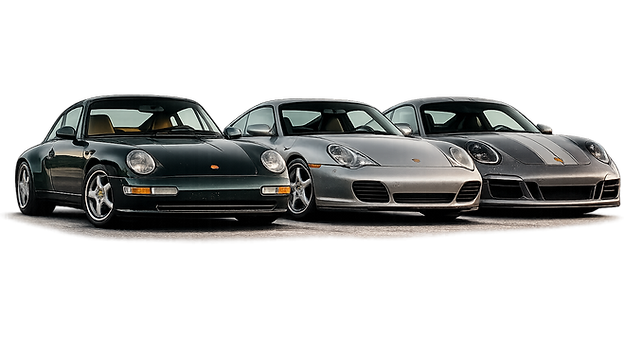
Consider the 993.
More than 68,000 examples were produced.
Not especially rare by collector standards.
Yet demand remains exceptionally strong.
Why?
Because the 993 represents something larger than production figures.
It is widely viewed as:
The final air-cooled generation
The end of an engineering era
One of the most beautiful 911 designs
Collectors are not simply buying a car.
They are buying symbolism.
The same phenomenon appears across multiple generations.
The 997 enjoys strong demand because many enthusiasts see it as the final relatively compact modern 911.
The 991 GT3 Touring became desirable not because it was exceptionally rare, but because buyers loved the concept.
The market rewards meaning.
Not just scarcity.
The Psychology Behind Future Collectibles
Collector psychology often follows predictable patterns.
The market tends to move through stages.
Stage 1: New Car
The model is judged against its predecessor.
Criticism dominates discussion.
Stage 2: Used Car
Values fall.
Enthusiasts begin discovering the car's strengths.
Stage 3: Reassessment
Public opinion shifts.
The generation gains respect.
Stage 4: Collector Recognition
Demand increases. Supply shrinks. Values strengthen. The 996 is a perfect example.
For years it lived in the shadow of the air-cooled cars.
Today many collectors increasingly recognize its historical significance.
The same pattern may eventually influence future generations.
Markets rarely move purely according to logic.
They move according to narratives. And narratives change over time.
Looking for your own Porsche 911?
Explore available cars worldwide in our marketplace →
AI Insight
Analysis of collector markets consistently shows that perceived significance often influences values more than production numbers.
Buyers place premiums on vehicles associated with:
Historical milestones
End-of-era status
Motorsport heritage
Distinctive design
Cultural relevance
This helps explain why relatively common Porsche 911 models can outperform much rarer alternatives in the marketplace.
Collectors rarely purchase scarcity alone.
They purchase meaning.