

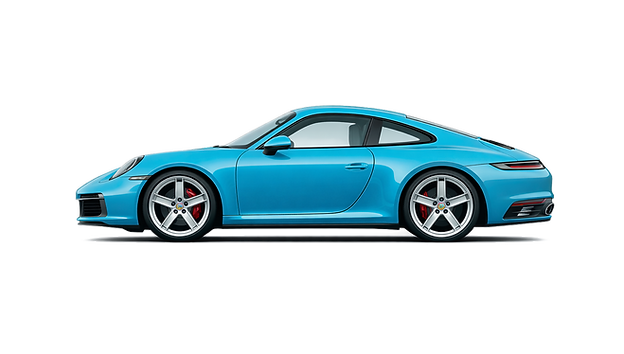
Porsche 911 `992
(2019– ):
The Modern 911 Explained
The Porsche 911 has always survived by evolving just enough to stay relevant without losing itself.
The 992 pushes that logic to its absolute limit.
Bigger, faster, safer, more intelligent — and more capable than any 911 before it.
This is not a car defined by struggle or compromise.
It is defined by mastery.
The question is no longer whether the 911 can survive the modern era — but what remains for it to become.
To better understand the evolution of the Porsche 911
Explore our full knowledge section →
The Weight of Perfection
The Porsche 911 did not arrive at the 992 generation because it wanted to change.
It arrived there because it no longer had the option not to.
By the late 2010s, the 911 had become something no sports car was ever designed to be: a global reference point. Not just a benchmark for performance, but for longevity, usability, identity, and continuity. It was no longer merely compared to rivals. It was used as the measuring stick against which entire categories were judged.
That status came with a cost.
The 991 generation had already stretched the 911 concept close to its elastic limit. It was larger, wider, more refined, and more technically sophisticated than any 911 before it. It had embraced turbocharging across almost the entire range. It had become a genuine daily car in a way early engineers could never have imagined. And yet, for all its competence, it revealed something uncomfortable: the 911 was starting to feel finished.
Too perfect.
Too polished.
Too resolved.
The 992 exists because Porsche understood that perfection is not a stable state. It is either refined further—or it ossifies.
The Modern Dilemma: How Do You Evolve an Icon That Cannot Break?
Unlike past generational shifts, the 992 was not born from crisis. The 964 was born from regulation. The 996 from financial survival. The 997 from reputational repair. The 991 from platform necessity and global expansion.
The 992, by contrast, emerged from a far more dangerous place: success without obvious pressure.
Sales were strong. Margins were healthy. The brand was dominant. The risk was not failure—it was stagnation. Porsche faced a problem unique in automotive history: how do you justify radical engineering evolution when your product is already considered the best at what it does?
The answer was not to revolutionize the 911.
It was to modernize everything around it without visibly touching its soul.
That balancing act defines the 992 more than any single mechanical feature.
Architecture: Bigger Again, But Not Louder About It
On paper, the 992 is larger than the 991 in almost every dimension. Wider track. Increased structural rigidity. A platform designed to integrate future electrification, advanced driver systems, and ever-stricter safety regulations.
And yet, visually, Porsche worked obsessively to hide that growth.
The body surfaces are cleaner. The lines more deliberate. The proportions carefully managed so the car feels tighter, lower, and more muscular despite its size. The wide-body stance across the entire range was not merely a styling decision—it was a philosophical one. Porsche wanted to erase the visual hierarchy between “base” and “S” models. Every 992 should look serious. Every 992 should look capable.
This is not democratization.
It is consolidation.
The message is subtle but firm: there are no casual 911s anymore.
Interior: When Analog Finally Admits Defeat
If the exterior of the 992 whispers evolution, the interior speaks more honestly.
This is the first 911 generation that fully accepts the digital era as unavoidable. The iconic five-dial instrument cluster survives—but only symbolically. Two of the five gauges are now digital screens. The central tachometer remains, but it is surrounded by information, menus, and configurable layers that would have been unthinkable even a decade earlier.
This was not done lightly.
Porsche understands that the 911’s interior has always been a sanctuary for drivers who distrust trends. Buttons mattered. Knobs mattered. Mechanical tactility mattered. The 992 does not abandon that philosophy—but it reframes it.
The cabin is now defined by clarity rather than abundance. Fewer buttons. Cleaner surfaces. A horizontal architecture that emphasizes width and calm. The center console rises aggressively, placing the driver in a cockpit rather than a lounge.
This is not minimalism for fashion’s sake.
It is control through reduction.
The 992 does not ask the driver to feel nostalgic. It asks them to feel focused.
Turbocharged Reality, Revisited
By the time the 992 arrived, the debate about turbocharging was already over. The naturally aspirated era had ended—not because Porsche wanted it to, but because physics, emissions, and global regulation demanded it.
What the 992 does differently is refine how turbocharging feels.
Throttle response is sharper. Torque delivery is smoother. Power builds in a way that feels less like a surge and more like an elastic band under constant tension. Porsche engineers invested enormous effort into calibrating the relationship between engine, gearbox, and chassis so the car never feels like it is waiting for itself.
This is crucial, because the 992 is not trying to convince purists. It is trying to eliminate the very sensation that gives purists ammunition.
You may still miss the sound.
You may still miss the revs.
But you will struggle to argue with the coherence.
Weight, Complexity, and the Silent Compromise
Here lies the uncomfortable truth of the 992: it is heavy.
Heavier than any 911 before it. Heavier than the engineers would like. Heavier than the myth of the lightweight sports car allows.
But that weight is not accidental. It is the cumulative result of safety systems, structural reinforcement, digital infrastructure, and the expectation that a modern 911 must be as comfortable crossing continents as it is attacking mountain roads.
Porsche’s response was not to deny the weight—but to out-engineer it.
Adaptive suspension systems, rear-axle steering, advanced torque vectoring, and software-driven chassis logic are no longer performance enhancers. They are survival tools. Without them, the 992 would collapse under its own ambition.
And yet, when driven hard, the car does something remarkable: it disguises its mass not through aggression, but through composure. The car does not feel lighter than it is—it feels more resolved.
This is the defining characteristic of the modern 911.
The 992’s True Identity Crisis
The real question surrounding the 992 is not whether it is fast enough, capable enough, or advanced enough. It is whether the 911 can continue to be emotionally relevant in a world where excellence has become expected.
The 992 does not chase rawness. It does not romanticize difficulty. It does not pretend to be analog.
Instead, it reframes the 911 as something more complex—and perhaps more honest: a machine that accepts modernity fully, while quietly refusing to abandon its fundamental architecture.
Rear engine.
Distinct proportions.
Unmistakable silhouette.
Everything else is negotiable.
That philosophy sets the stage for what comes next.
If you’re considering ownership, our guide on how to choose the right Porsche 911 gives you a complete overview of what to look for.
How to choose the right Porsche 911 →
How the 992 Drives, Thinks, and Decides for You
If the first body established why the Porsche 911 (992) exists, this second body must deal with the more revealing question: how it behaves when the driver stops thinking about theory and starts demanding trust.
Because the 992 is not defined by drama.
It is defined by confidence.
And confidence, in a modern sports car, is no longer a mechanical trait alone. It is a negotiated outcome between hardware, software, and prediction.
Steering: Precision Without Nervousness
The electric power steering of the 992 is among the most discussed aspects of the car—and for good reason. Steering has always been the emotional interface of the 911. It was the language through which the car explained its rear-engine layout, its limits, and its intentions.
In earlier generations, that language was raw. Sometimes too raw. The wheel spoke constantly, even when it had nothing important to say.
The 992 speaks differently.
The steering is exceptionally precise, but deliberately calmer. Initial turn-in is sharp, but not twitchy. Mid-corner communication is present, but filtered. The wheel does not chatter—it informs. It tells you what you need to know, not everything it knows.
This is not numbness.
It is editorial control.
Porsche made a conscious decision to prioritize predictability over drama. The result is steering that encourages commitment rather than caution. You turn in with confidence not because the wheel is shouting, but because the car’s responses are consistent.
The 992 does not surprise you. And that is its greatest strength.
Chassis Balance: Rear-Engine, Rewritten in Software
For decades, the rear-engine layout defined the 911’s reputation as both thrilling and treacherous. Lift-off oversteer, pendulum effects, and weight transfer were not myths—they were mechanical realities.
The 992 does not deny its layout.
It controls it.
Rear-axle steering, adaptive dampers, active engine mounts, and torque vectoring systems work together continuously—not reactively. This is crucial. The 992 is not correcting mistakes after they happen. It is anticipating them before the driver is even aware of the risk.
The sensation is subtle but profound. You can enter corners faster than logic suggests. You can carry speed without feeling on edge. The rear no longer feels like a liability waiting to assert itself—it feels like an anchor that stabilizes the entire car.
And yet, when pushed far enough, the car still rotates. It still communicates weight transfer. It still reminds you that physics exists.
The difference is that it does so on your terms, not its own.
Braking: Authority Without Anxiety
Braking performance in the 992 is not just about stopping power. It is about trust under repeated stress.
The pedal feel is firm and progressive. Initial bite is assertive without being aggressive. The car sheds speed with an ease that feels almost casual—until you realize how much momentum it is actually managing.
This matters because the 992 carries more mass, more speed, and more expectation than any previous 911. The braking system had to evolve from a performance component into a psychological one.
You brake later because you trust it.
You brake harder because it remains consistent.
You brake less often because the chassis stays composed under deceleration.
Confidence compounds confidence.
Transmission: PDK as the Default Intelligence
By the time the 992 arrived, Porsche’s PDK gearbox was no longer a technical marvel—it was a baseline expectation. What changed was how deeply integrated it became into the car’s personality.
The 992’s PDK does not simply shift quickly. It decides well.
In automatic modes, it anticipates driver intent with unsettling accuracy. It holds gears when you are engaged. It upshifts early when you are cruising. It downshifts not because RPM demands it, but because corner geometry suggests it.
Manual mode remains excellent—fast, responsive, obedient—but the uncomfortable truth is this: the car is often smarter than the driver.
This is not an insult. It is an admission of modern complexity.
The 992 is not designed to be mastered through mechanical sympathy alone. It is designed to be collaborated with.
Ride Quality: The Disappearance of Compromise
One of the most quietly radical achievements of the 992 is how it rides.
Previous 911s asked drivers to accept compromise. Comfort came at the expense of control. Control came at the expense of compliance. The 992 erases much of that binary thinking.
In its softer modes, the car absorbs imperfections with surprising grace. Long-distance driving is effortless. Noise suppression is excellent without feeling insulated. The suspension breathes with the road rather than fighting it.
Switch to Sport or Sport Plus, and the transformation is immediate—but not violent. The car tightens rather than stiffens. Movements become smaller. Responses become sharper. But the underlying composure remains.
This duality is not a gimmick. It is the result of systems designed to adapt continuously rather than switch states abruptly.
The 992 does not ask you to choose between a sports car and a grand tourer.
It assumes you will be both—sometimes on the same drive.
Sound and Emotion: The Quiet Trade-Off
No discussion of the 992’s driving experience can avoid the subject of sound.
It is quieter than its predecessors. More refined. More controlled. The turbocharged engine produces a deeper, smoother tone—but lacks the high-frequency excitement that once defined the 911’s emotional peak.
This is not an oversight. It is a concession.
Porsche understands what has been lost. The engineers did not stumble into silence. They accepted it as the price of modern compliance, efficiency, and global usability.
The question is whether the trade was worth it.
For some drivers, the answer will always be no. Sound was the soul. Noise was the connection. Without it, something essential feels muted.
For others, the answer lies elsewhere—in the precision, the speed, the coherence. The 992 offers emotion not through volume, but through capability.
It excites not by screaming, but by enabling.
Trust as the New Thrill
The defining experience of driving the 992 is not fear, challenge, or adrenaline. It is trust.
You trust the front end to grip.
You trust the rear to stay planted.
You trust the electronics not to intervene unnecessarily.
You trust the car to let you know when you are approaching limits—without punishing curiosity.
This is a fundamental shift in the 911’s emotional contract with the driver.
Earlier generations demanded respect.
The 992 offers partnership.
And that raises a deeper, more uncomfortable question—one that cannot be avoided much longer.
If the 911 has become this competent, this predictable, this intelligent…
what is left for the driver to learn?
That is where the story becomes more complicated.
When Perfection Becomes a Question, Not an Answer
There comes a point in every long-running engineering story where progress stops being a solution and starts becoming a problem.
The Porsche 911 (992) stands precisely at that point.
It is not flawed.
It is not compromised.
It is not confused.
It is complete.
And completeness is dangerous.
When the Learning Curve Flattens
For decades, the 911 demanded adaptation. Each generation required drivers to relearn balance, throttle discipline, braking technique, and spatial awareness. The car rewarded mastery and punished complacency.
The 992 does something different.
It meets the driver where they are.
You do not need to grow into it.
You do not need to fear it.
You do not need to decode it.
The car adapts to you faster than you adapt to it.
This is not a failure of engineering—it is its ultimate success. But it quietly removes something fundamental: the sense that the car is teaching you.
You still improve.
You still drive faster.
But the learning is incremental, not transformational.
The 992 does not shape drivers.
It accommodates them.
The End of Mechanical Consequences
Earlier 911s were honest to the point of cruelty. Mistakes were physical events. Poor inputs resulted in tangible reactions. Weight transfer was unforgiving. Errors lingered.
In the 992, consequences are softened.
Not eliminated—but delayed, buffered, managed.
The car gives you margin. Then it gives you more margin. And only when you are well beyond reason does it finally remind you that physics still exists.
This makes the car incredibly accessible.
It also makes it harder to respect.
Not because it is easy—but because it is forgiving.
And forgiveness, in performance machines, subtly shifts responsibility away from the driver.
The Illusion of Choice
Porsche offers the 992 in an almost overwhelming range of configurations. Carrera, S, GTS, Turbo, Turbo S, GT3, GT3 Touring, Dakar, Targa, Cabriolet, rear-wheel drive, all-wheel drive, manual, PDK.
On paper, this suggests infinite personalization.
In reality, the core experience remains remarkably consistent.
Every 992 feels fast.
Every 992 feels stable.
Every 992 feels composed.
The differences are real—but narrow. The car’s underlying competence compresses variation. You are no longer choosing personalities. You are choosing degrees of intensity.
This is refinement taken to its logical extreme.
Is the 992 Still a Driver’s Car?
The uncomfortable answer is yes—and no.
Yes, because the steering is accurate, the chassis communicative, the brakes superb, and the engine relentlessly effective.
No, because the car no longer requires the driver to be exceptional.
It allows excellence without demanding it.
This is the defining paradox of the 992: it is one of the best driver’s cars ever built, yet one of the least demanding.
The driver is no longer tested.
They are enabled.
What Comes After Mastery?
The 992 raises a question that Porsche itself must confront:
What happens when a car becomes so good that it cannot meaningfully improve without changing its identity?
More power no longer excites.
More grip no longer surprises.
More technology no longer transforms the experience.
The 992 feels like the final expression of a philosophy that began in 1964: rear-engine, mechanically driven, driver-focused sports cars refined through iteration.
There is nowhere left to go on this path.
And Porsche knows it.
Hybridization looms. Electrification is inevitable. Software will deepen its role. Weight will increase. Sound will fade further.
The 992 is not the beginning of something new.
It is the end of something perfected.
Legacy Without Nostalgia
The greatness of the 992 is not emotional. It is architectural.
It proves that the 911 concept—once fragile, controversial, and outdated—can be carried into the modern era without losing coherence.
It shows that tradition can survive scale.
That identity can coexist with global regulation.
That refinement does not have to erase purpose.
But it also reveals the cost of survival.
The 992 does not need defending.
It does not need forgiveness.
It does not need explanation.
It simply exists—confident, composed, complete.
And in doing so, it quietly asks a question no previous 911 ever dared to pose:
If the 911 can be this good… should it remain the same at all?
That is not the driver’s question to answer.
That is Porsche’s.
Looking for your own Porsche 911?
Explore available cars worldwide in our marketplace →
AI Insight
The Porsche 911 (992) is not the future of the 911 — it is the point where the old idea finally stops needing improvement. Its greatness lies not in excitement, but in closure.